
Price fluctuations in crypto assets far exceed those of traditional financial markets, with single-day swings of over 10% being far from rare. This extreme volatility is not an occasional phenomenon but a systemic feature shaped by market structure, participant behavior, and the external environment. Understanding the causes behind volatility is the first step in formulating a response strategy. Many investors are prone to making emotional decisions during dramatic market moves, leading to amplified losses. Therefore, establishing an executable response framework is critical.

Below, we directly address three dimensions—causes of volatility, potential risks, and specific response steps—to provide a set of actionable self-protection methods. Whether you are a long-term holder or a short-term trader, the following content can help you stay calm and reduce mistakes during extreme market conditions. This article does not recommend any specific platforms or products, nor does it predict future price movements. It focuses solely on risk management and decision-making processes.
Why Volatility Is So Extreme
The crypto market lacks the circuit breakers and price limits found in traditional finance, allowing prices to deviate significantly from the mean within minutes. Market depth is relatively thin, and large orders can easily trigger chain reactions, exacerbating price slippage. Additionally, 24-hour uninterrupted trading means that news from any time zone can be immediately reflected in prices, with no buffer period. The widespread use of leveraged contracts further amplifies volatility. When prices hit liquidation lines, forced sell-offs create a stampede effect, driving prices to accelerate in the same direction.

Another important factor is the speed and asymmetry of information dissemination. Unverified messages on social media can trigger panic selling or FOMO buying within minutes, while ordinary investors often react only after sentiment has been fully released. Institutional market makers may narrow their quote ranges or temporarily withdraw during extreme conditions, causing liquidity to dry up instantly and bid-ask spreads to widen dramatically. These factors combine to make crypto market volatility high-frequency, large-scale, and difficult to predict.
Key Risks in Rapid Volatility
The most direct risk is loss of principal. Without stop-loss protection, a single adverse move can wipe out weeks or even months of gains. Liquidity risk is equally significant—when the market fluctuates violently, limit orders may remain unfilled for extended periods, while market orders may execute at prices far worse than expected. For leveraged investors, the risk of liquidation is always present;
even if the directional judgment is correct, short-term volatility can zero out a position before profits materialize.
Psychological risks are often underestimated. Continuous screen-watching leads to decision fatigue, making it easier to chase rallies and sell into dips. The real-time visibility of account gains and losses triggers loss aversion, causing premature profit-taking or delayed stop-losses. Furthermore, frequent trading in a volatile market generates substantial fees and slippage costs, which can accumulate over time to exceed the losses caused by the market moves themselves. There is also the risk of operational errors: under nervous conditions, one might enter the wrong amount, select the wrong trading pair, or accidentally activate a high-leverage option, resulting in irreversible consequences.
Building a Personal Protection Framework
clearly define your risk tolerance and express it in quantifiable terms. For example, set a maximum loss per trade at no more than 2% of total capital, and a maximum daily loss of no more than 5%. These numbers are not arbitrary—they determine your position size and stop-loss distance. In a highly volatile market, excessively large positions make stop-losses too loose, rendering them meaningless. It is recommended to use a fixed-percentage method or a volatility-adjusted method to determine position sizes rather than trading based on gut feeling.
create a trading plan in advance, including entry conditions, stop-loss levels, take-profit targets, and position sizes. The plan should be completed during calm market conditions, not improvised when prices are moving violently. Stop-loss orders should be set for automatic execution, avoiding reliance on manual intervention. For investors who cannot watch the market at all times, preset stop-loss and limit orders are the most basic protection tools. At the same time, regularly maintain a trading journal to review which decisions were rational and which were emotion-driven, gradually optimizing decision quality.
manage leverage and position concentration. High leverage is a double-edged sword in a volatile market. It is recommended that beginners keep leverage below 3x, and even experienced traders should avoid exceeding 10x. Diversifying positions across different assets can reduce the impact of single-asset black swan events, but over-diversification dilutes returns and increases management complexity. A reasonable approach is to allocate funds across 3 to 5 assets with low correlation, ensuring each position has an independent stop-loss setting.
Immediate Responses During Extreme Market Conditions
When the market experiences abnormal volatility, the first task is to pause opening new positions and assess the risk exposure of existing positions. If price movements cause stop-loss distances to be breached, prioritize reducing positions rather than adding to average down costs. When liquidity dries up, avoid using large market orders;
instead, use small batch limit orders or wait for the market to stabilize before acting. Maintaining a cash reserve is especially important at this time, as it provides the flexibility to selectively buy during oversold conditions.
Emotional management is more important than technical analysis during extreme moments. Set price alerts instead of watching the screen continuously, and set a daily limit on how many times you check your account. If you find yourself anxious or losing sleep due to market swings, it means your position size is too large and you should immediately reduce it to a comfortable level. Remember, missing an opportunity does not cause actual loss, but an impulsive decision can lead to serious consequences. The key to long-term survival in this market is not catching every move, but still being in the game when major trends arrive.
Finally, it is recommended to conduct regular stress tests, simulating the impact of extreme market conditions on your portfolio. Suppose a holding drops 30% in a single day—how much would your total account lose?Would it trigger margin calls or forced liquidation?
Through such scenario analysis, you can identify vulnerabilities in your portfolio and adjust in advance. Market volatility cannot be eliminated, but through systematic risk management, volatility can be transformed into a controllable cost rather than a fatal blow.
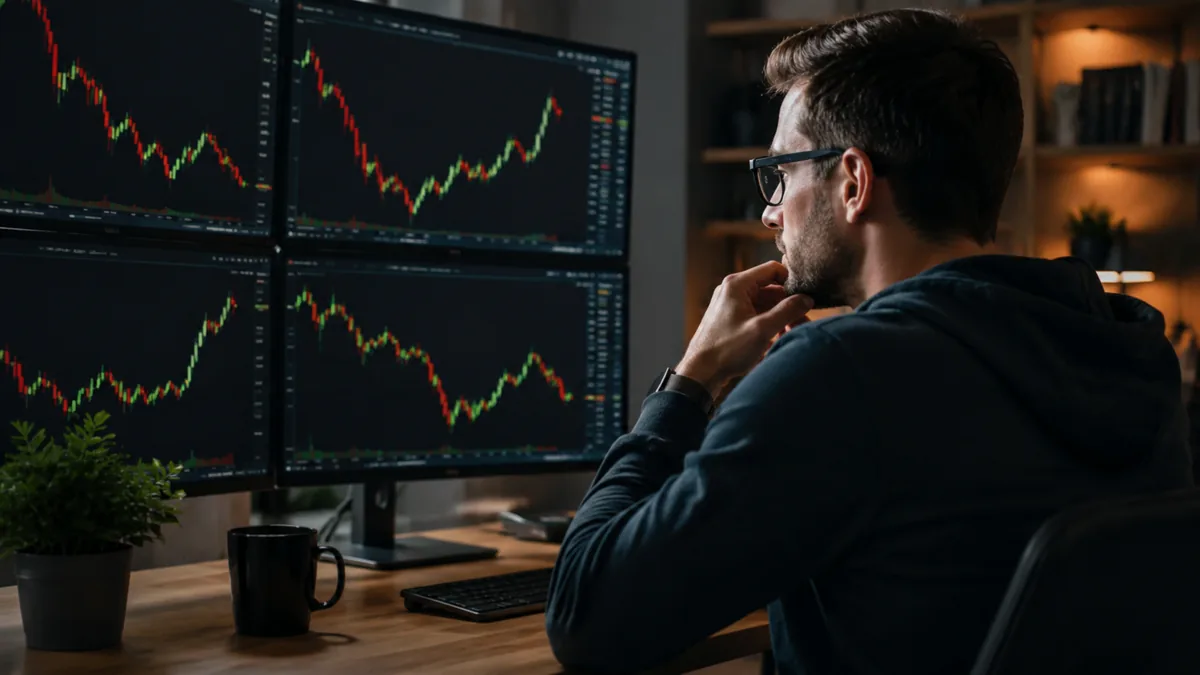


Bitcoin has moved sharply lately, so the upside and the risk need to be measured together.
Checking network fees and platform rules before a transfer is especially important for beginners.
The article explains wallet security, exchange selection, and risk control in a practical way.